"Whose Hands Are These?" — Narrative Perspective and the Audience's Body in Immersive Theater Strategies
This article was first published in SCREEN, 2026. (Responsible Editor: Shih-yu Hsu)
Introduction
Unconventional theater incorporating technological media has flourished in recent years, no longer leaving the audience invisible but making them “characters” to varying degrees. Such works often claim to let audiences freely explore the boundaries of perception and arrive at different interpretations through different points of view. However, having actually sat through several of these performances, I’ve come to feel that this “freedom” — meant to reach the audience’s bodily experience, not just remain formal, and to do so within the compressed time and space of a live show — is no simple thing to pull off. In 2026, LuxuryLogico’s unmanned theater piece The Last Question and House Peace’s extended-reality theater Beastosis: Call of the Skull, co-produced with ET@T, use very different technologies, yet converge on a similar goal in how they handle “hands,” “point of view,” and immersive staging more broadly: reserving the viewer a specific “standpoint” within the performance, experienced through an immersive perspective. This essay compares the two productions from my perspective as an audience member, examining how each strategy pulls the audience into the performance’s structure and turns them into characters — and how that plays out in the audience’s bodily experience.
A Stage Where the Audience “Co-Performs”
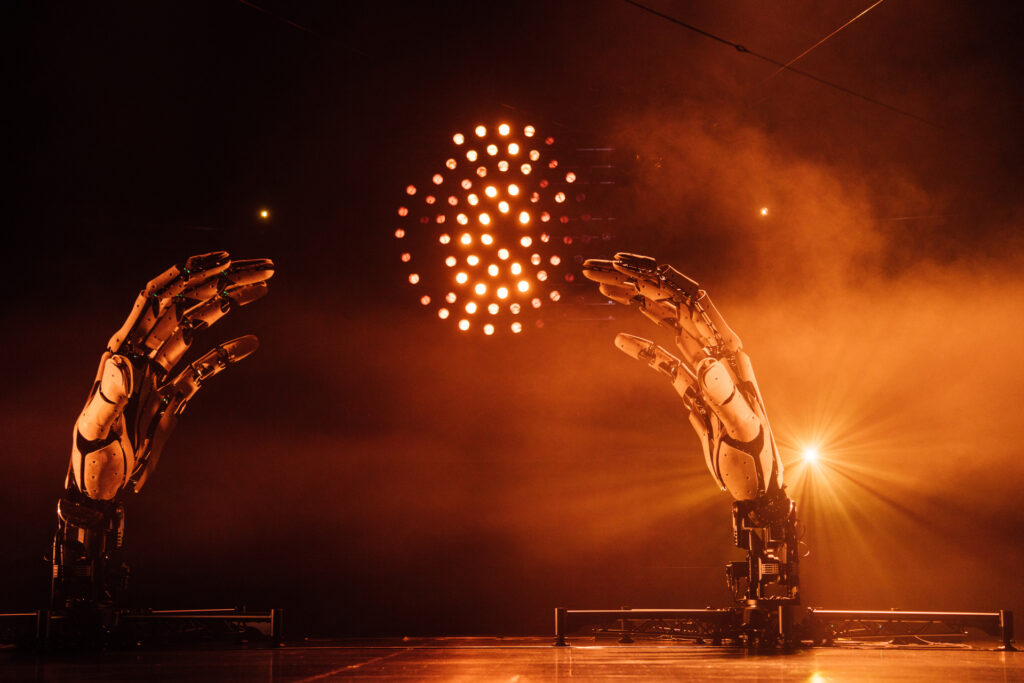
“These are my hands! I thought my hands were gone.” A girl’s voice fills the stage and the empty auditorium. In The Last Question, the audience sits on the stage itself, while the seating below sits vacant, serving as a backdrop. Before the curtain rises, they watch orbs of light, projections, and the movements of a pair of giant mechanical hands; once the curtain lifts and light spills across the empty seats, the audience seems folded into the performance — what plays out is not only the artists’ story, but each viewer’s own. Yet as the piece unfolded, I kept feeling this intention short-circuit: with every shift in form, whose hands were these? Whose thoughts was I hearing? Whose gaze was I seeing through? Was I meant to stay an observing bystander, or step into the character’s first-person view and briefly become the narrative’s “I”?
Entry begins with the audience queuing at a fire exit; inside, the seating isn’t the familiar grand hall but a temporary tiered structure built on the stage itself, facing what would normally be the auditorium. Before the show starts, a faint yellow light falls on this tiered seating while center stage stays dark — the audience can just make out machinery humming, and a small mechanical orb soon to stand in for the narrator. Once the light fades, the orb ignites and two scrims descend, opening the story. The curtain still hasn’t risen; the audience can’t yet see the seats below.
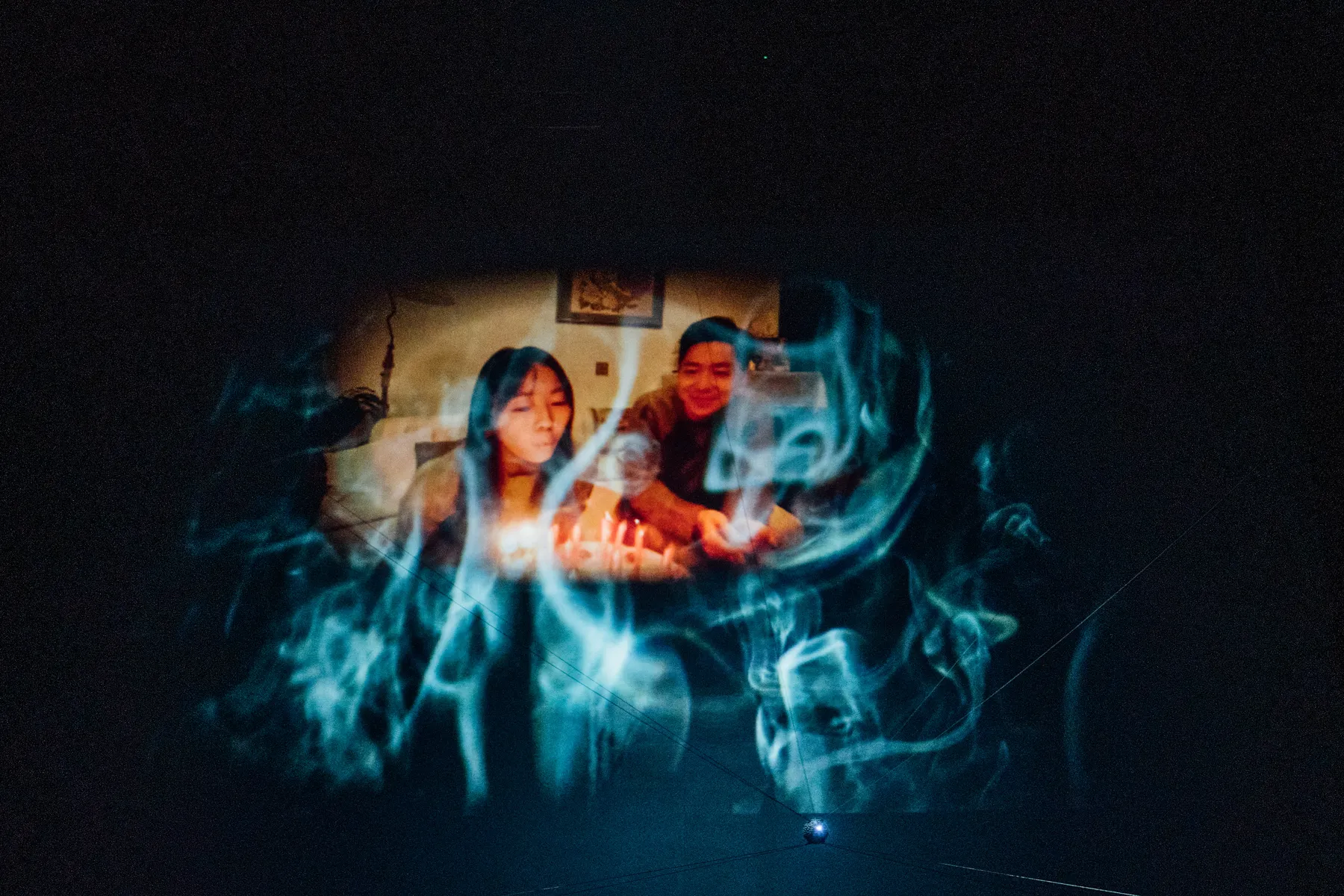
The first scrim shows a child’s crayon-animation, a girl’s voice narrating fragments of childhood with her father. The scene shifts to a second scrim — voice-over becomes dialogue, father and daughter interacting, then the grown daughter alone at a desk, remembering him. When the fragments end, the figures freeze and the image suddenly gains depth, the camera pulling back to look down on them — the audience senses, here, that the father may already be gone.
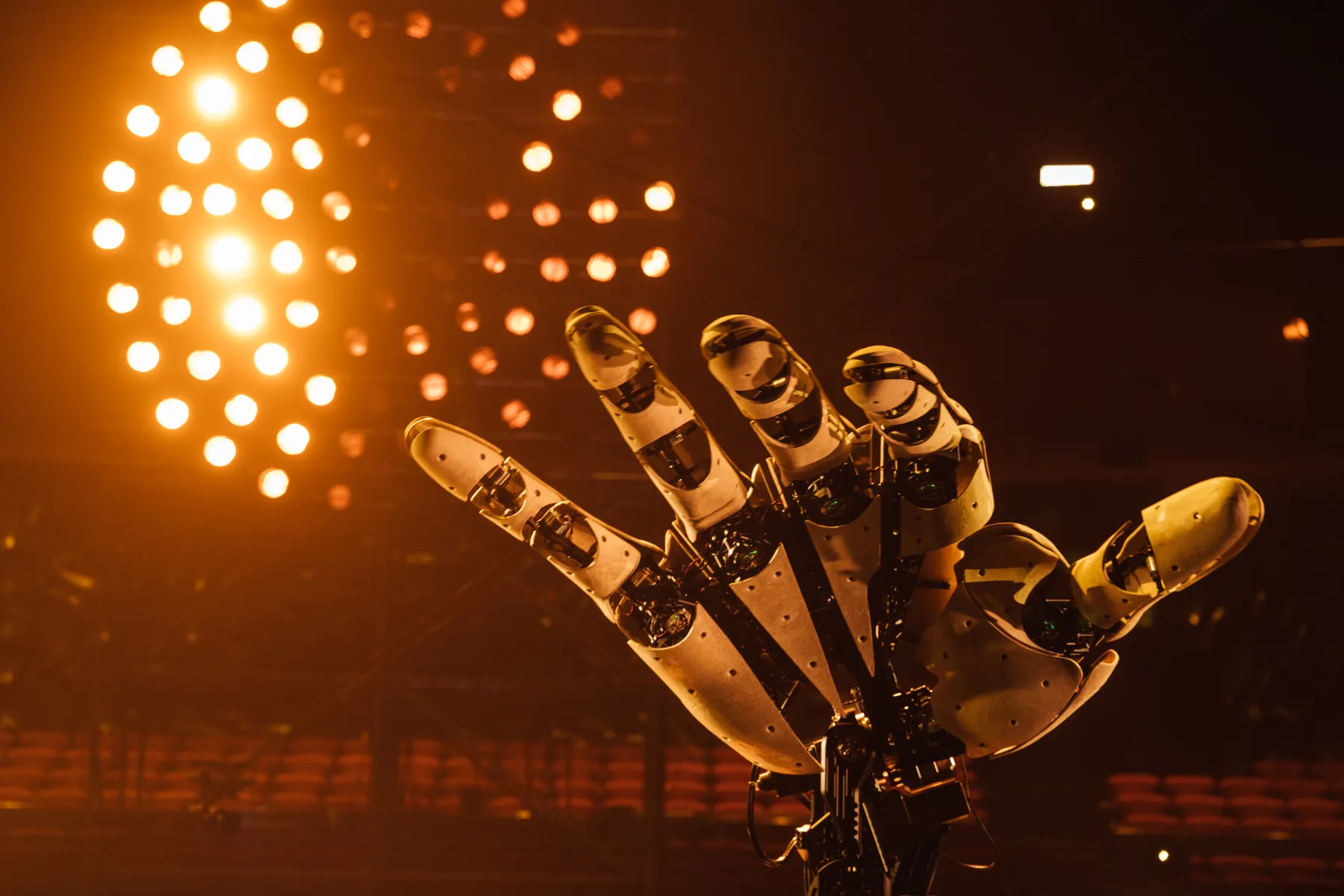
Then the curtain and scrims rise together; the audience now sees the giant mechanical hands directly, looming over the now-visible red seats. Music shifts abruptly — dense, emotional, almost like switching to another entirely different film. When the girl’s voice says, “These are my hands! I thought my hands were gone,” I found myself wondering: is this her dying moment? A flash of memory with her father, just before crossing into his world — the world of spirits. The hands begin to move — gripping, stretching, swaying with the music — and the audience in the tiered seats seems to occupy their owner’s position, imagining themselves as both the daughter and the small orb onstage. Throughout, that first orb — its shell built from many points of light glowing outward, and the inner beam glows from within, casting shadows like a city skyline — drifts through the stage space; later, a second orb appears above the empty seats, the two lighting and moving in turn, as if conversing within this drama that is life itself.
Where Am “I”?
The stage tries to tell the audience they are at once the spectator of someone else’s life and the performer of their own. The audience occupies the perspective of the hands’ owner, while the orb — gliding on tracks and cables — seems to be the consciousness behind the voice. Moving from parental memory to the divide of life and death to a meditation on existence, the piece invites the audience to project their own experience onto the daughter. With no physical actors, only voices, the audience can be both first-person “I” and second-person “you”: when the daughter asks “Where am I?” and the father answers “You are inside your question,” it feels like he’s speaking to her and to us at once. This, to me, is the real potential of the show’s spatial design — the way it lets “narrative immersion” and “bodily immersion” intersect. Narrative immersion pulls the viewer into a fiction, letting them forget their own presence and drift, ghost-like, into a character’s perception; bodily immersion asks the viewer to bring their own presence into the scene, layering the situation’s filter over their own eyes so they naturally become part of it.
These two strategies aren’t incompatible — they meet through role-play. With the right character framing as mediator, an audience can inhabit a character’s inner state while still engaging with the surrounding environment, without feeling out of place. But in The Last Question, the roles the creators ask the audience to shuttle between — projecting into father and daughter, versus bringing themselves onstage as a symbolic performer — never quite cooperate, and the audience can’t move smoothly between them. I suspect this is LuxuryLogico, usually so fluent in bodily immersion, tripping over its own feet as it moves from exhibition space to theater: the fixed “running time” of a show becomes a constraint born of anxiety over thin content, rather than a springboard for the work to evolve.
In LuxuryLogico’s earlier work, audiences mostly entered their built environments “as themselves,” observing shifts in their own perception. As the group has put it, they want “to offer a time and space where the audience can find their own point of view, creating an experience that includes them.” 1 Their strength lies in letting the body move freely, hunting for the work’s best vantage point, without presupposing how long anyone should linger. Brought into a theater, that strength runs up against fixed seating and a fixed runtime. They give the audience the conditions for bodily immersion — walking onstage, becoming part of the show — while also pushing them to empathize with father and daughter, requiring a temporary (sometimes simultaneous) identification with one or the other. But the narrative isn’t dense enough, the way a film or drama is, to sustain “becoming someone else” for long: what we hear and see are lines cut off from lived experience, family-memory imagery close to cliché, as sentimental as an overwrought commercial. Because the characters lack depth, there’s little room to actually project into them — unless a viewer’s own memories happen to be triggered, they’re likely to stay unmoved. The back half leans hard on music to manufacture sorrow, which itself betrays some unease, on the creators’ part, about how thin the story really is.
Looking back at LuxuryLogico’s recent solo show Cosmic Sketches (2025), 2 winner of the Taishin Arts Award, the installation Hard, Hard (2019) might be read as a miniature version of The Last Question’s entire stage. There, viewers move freely around a city model while a small orb drifts through it, holding a deliberately simple role: a small consciousness any viewer can project onto — a look back at childhood, perhaps, or a departed soul’s return — entirely dependent on how each person reads it. The Last Question takes that same orb — a position the audience once moved freely in and out of — and loads it with the daughter’s memory of her father, forcing viewers to read it as one or the other, tethering their perspectives to the creators’ own script.
Perhaps there’s another way to defend the piece: maybe it never meant to offer “narrative immersion” at all, and only ever wanted the audience to watch the father-daughter story as bystanders who happen to be onstage. That may well be exactly what the creators intended. But in doing so, they overlook something: once an audience is pulled from the anonymity of a traditional auditorium up onto the stage, made to see themselves as part of the show, and then sees these giant hands — gripping, stretching, swaying as if seeing one’s own pair of hands — from the stage to the seating below, they inevitably read it as an extension of themselves. Hearing the daughter say “These are my hands!” right after only makes the audience’s role and the daughter’s role collapse into one another. That overlap — or slippage — between the two roles needed more careful handling, or one of them should have been simplified away.
To Occupy a “Standpoint”: Perspective, Voice, and the Sense of Presence
Beastosis: Call of the Skull, by contrast, assigns the audience a clear role from the outset — apprentices learning Mimesis from a Mimesist — and defines what Mimesis means: by imitating others, you see the world through their eyes. Drawing on the novel’s own narrative logic, the adaptation lets “narrative” and “bodily” immersion work together smoothly. Even as the audience’s perspective shifts between their own (via VR pass-through) and that of the Mimesist Luan and his brother Taibang (VR virtual view), the concept of Mimesis and the technical fact of “seeing through a headset” reinforce each other so well that the audience’s presence always feels justified. And although given a role, the audience isn’t burdened with excess character logic or tasks. Despite using XR to more fully envelop and control the audience’s field of vision, Call of the Skull actually leaves more psychological room to step back from the character than The Last Question does. I’d even argue it confronts the question of “whose hands, whose gaze” more deeply — folding it into its medium and form rather than handing it to the audience as dialogue.
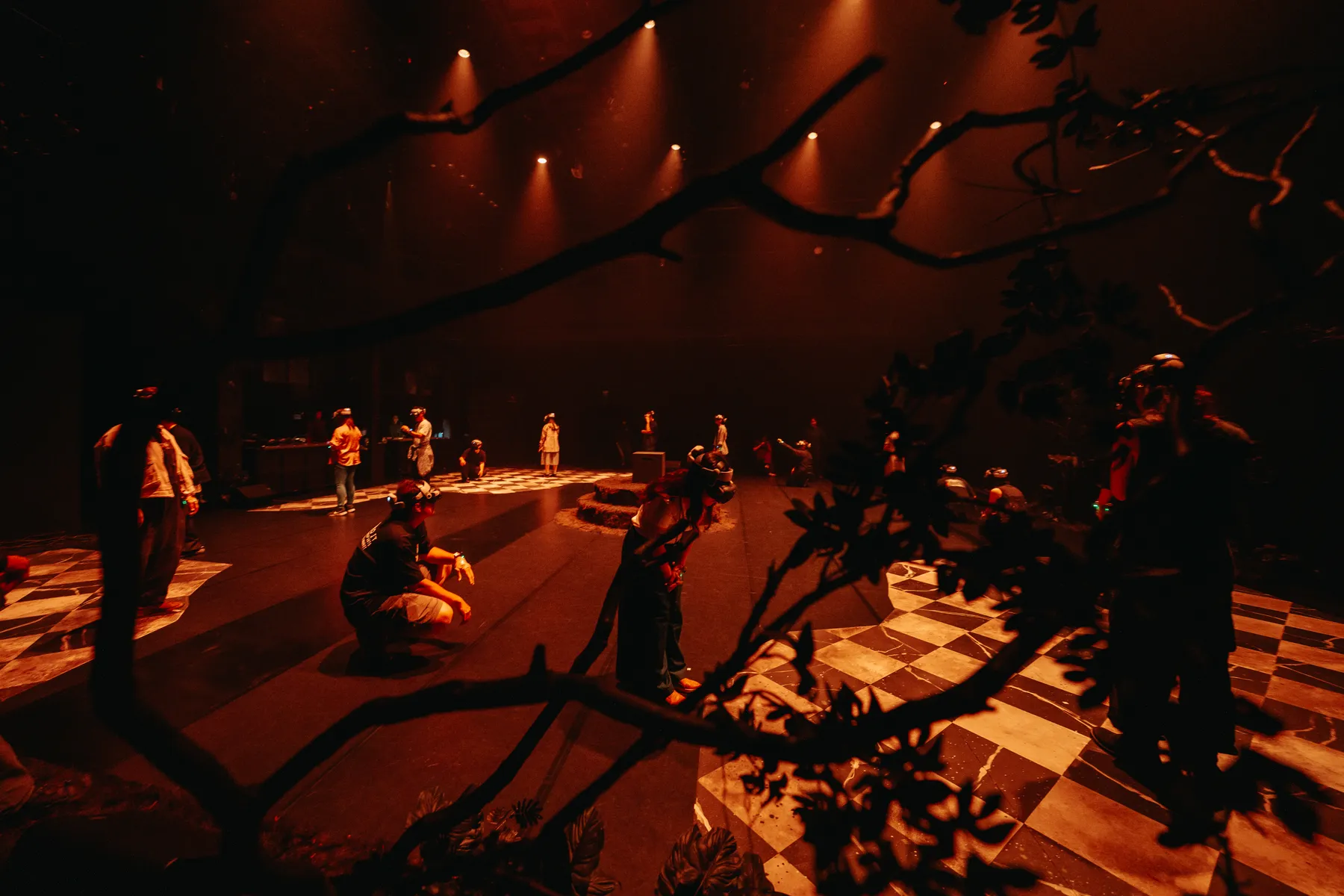
After taking turns with an interactive wristband and headset, a dozen or so audience members wander freely through the space. Through pass-through mode, the physical theater is captured by the headset’s camera and overlaid with 3D animation into a mixed reality, letting the audience interact and practice the Mimesis technique “Fabrication.” When the actor playing Luan enters, the audience becomes his apprentices, able to see through the eyes of whoever’s being mimicked — and following Luan’s own view, they enter the animated virtual world, the “Shadow World.” Even carrying this role, I still felt it was “I” exploring the space, with Luan simply guiding me and telling his story — while occasionally I could also empathize with him, imagining he was looking at exactly what I was.
This apprentice framing smooths the psychological transitions between perspectives. Once the audience reaches the shaman’s dwelling, the headset switches to mixed reality: the theater reappears, along with the shaman — until now present only as a voice — and Luan’s body returns to view. Everyone stands together in a circular corridor, facing two performers in the courtyard. The white railings and sprawling vines are animation; the two real actors, seen through the headset’s camera, stand within that virtual scene. Their physical presence gives the audience coordinates in both the theatrical and virtual space at once, and makes the novel’s “Real World” and “Shadow World” feel like two sides of one whole.
Even in an age reliant on remote communication, another person’s presence still changes everything. Even unseen and unheard — somewhere in the dark, out of view — simply knowing someone shares your space changes how you feel it. In one scene, through Luan’s memory, the audience revisits the night before his brother’s disappearance, walking through the home he shared with Taibang. As his voice murmurs in our ears, the shaman suddenly passes behind me, chanting — I can’t see her, but I feel her: footsteps approaching and receding, song swelling and fading, the air stirred by her body. When that breeze brushes my back, I remember, with a start, that I’m not watching the present, but something that already happened.
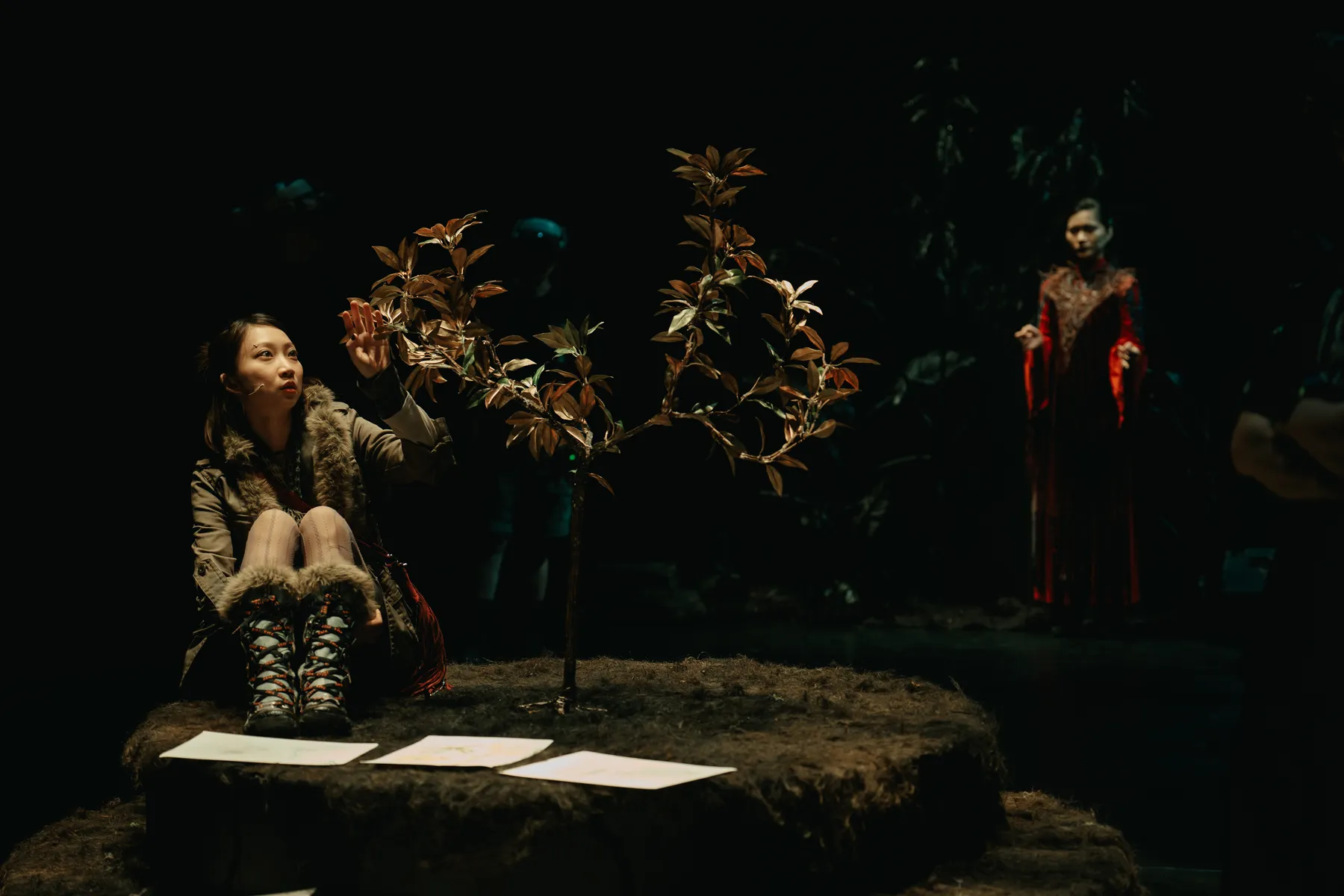
Bringing live actors into an XR theater this dense with 3D scenes is expensive — and worth it. Though two performers appear in Call of the Skull, they’re rarely fully visible; more often, it’s their bodily presence and voice that “coexist” with the audience, rather than appearing before them directly. The Last Question, by contrast, markets itself as “unmanned theater” with “no actor speaking lines,” 3 even though pre-recorded voice makes up much of the show — yet hearing these voices doesn’t make the audience feel the father and daughter’s souls actually share the space. Creating a speaker’s sense of presence through voice alone isn’t just a question of acoustic realism; it needs a psychological groundwork — whether that’s the audience’s awareness of real actors nearby, as in Call of the Skull, or the lingering, irrational belief in the supernatural after watching a horror film — before a voice can feel truly “present.”
The Hand as Mediator
Both works center on audiovisual effect, and “hands” matter to each. The Last Question fuses the mechanical hands, the staging, and the audience’s viewpoint visually, while Call of the Skull goes further, using the hands’ touch and operability too. At first glance, the audience’s hands seem beside the point in Call of the Skull — unlike the eyes, they don’t take in spatial data; unlike the ears, they don’t process speech or sound; unlike the legs, they don’t move you through space; and the story itself doesn’t substantively change because of the Mimesis gestures we trace. So what does this hand-based interaction actually awaken, bodily?
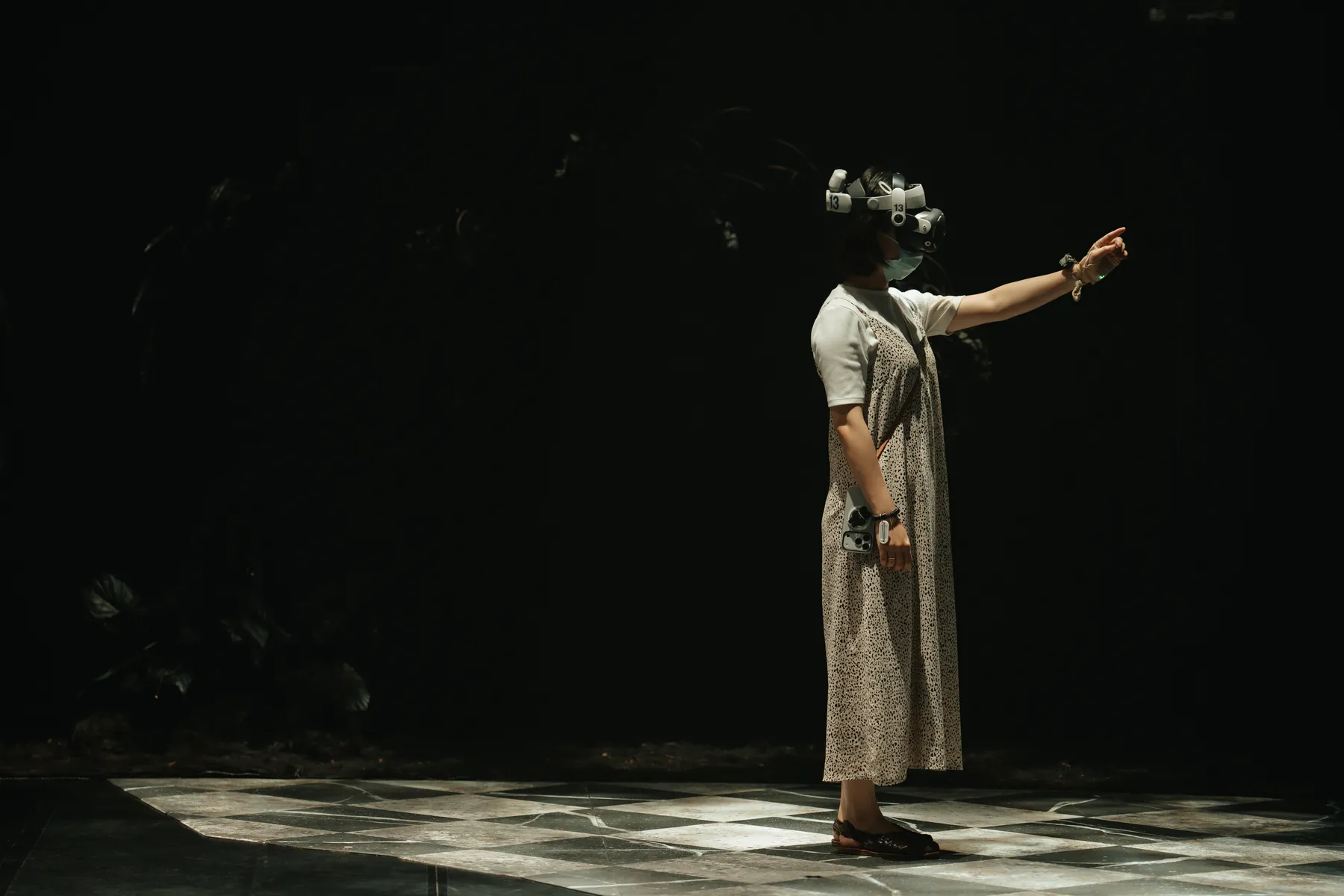
Even though the integration of Mimesis and XR technology already feels complete on its own terms, the hand still serves as a finishing touch — a mediator that tightens the bond between the two. The headset’s camera reads our gestures and renders them back in the virtual world — Luan’s black-painted nails, or Taibang’s scarred hands; now and then, we’re prompted to lift an oil lamp, or crouch to stroke the clouded leopard. The reason the audience can buy into “because I mimic, I see” is largely because — thanks to the creative team’s restraint with interactive cues — the hand becomes the audience’s only visible proof of their own presence in the virtual world, anchoring the real and virtual together and giving a real sense of participation. At the same time, the fact that our hands can still move freely across perspective shifts confirms that we’re only ever the Mimesist’s apprentice, never Luan himself — so we never feel we have to project into his inner state to stay invested, even as we can still empathize with him, the way we do with anyone in daily life.
We only ever see our own face through a mirror or a camera; our hands, by contrast, are visible almost constantly, always interacting with our surroundings. Looking at them is how we confirm our capacity to act on the world — a habitual way of telling reality from dream. In my own dreams, I rarely recall seeing my hands at all, which often leaves the dream-“I” feeling outside my own control. Film and television often use this too — a first-person shot of a character looking at their own hands and trying to grasp, marking the moment of waking from sleep or coma, trying to tell if they’re truly conscious. Back to The Last Question: I think the giant hands’ movement is, visually, a metaphor for the hand as a mediator between self and world. But understanding a metaphor is one thing — how does it connect directly to bodily perception? Set against Call of the Skull, I find myself imagining what role “the audience’s hands” might have played there instead, and what it might mean to actually “interact” with those giant hands.
About “The Plurality of First Person”
The writing project series “The Plurality of First Person: The Audience as a Hidden Character” was initiated by LIN Pei-Yao (林沛瑤), working from her triple viewpoint as creator, researcher, and viewer. Amid a digital-technology environment increasingly oriented toward real-time interaction, the project asks how “interactivity,” broadly conceived, comes into being within contemporary art exhibitions and performances — through the viewer’s own experience of presence. Its objects of observation span time-based works across Taiwan’s art scene, including media art, theatre, and immersive performance, examining the interactive conditions, perceptual arrangements, performativity, and viewer-performance relations at play within them. Using critical observation as its method, the project develops an ongoing body of research under the heading “A Phenomenology of Interactivity,” and is supported by the National Culture and Arts Foundation’s 2026 “Phenomenon Writing — Visual Arts Criticism Project.” (Supporting organizations: National Culture and Arts Foundation; Winsing Arts Foundation)
Special Thanks: Wave Yang
Quote from “Cosmic Sketches — LuxuryLogico Solo Exhibition,” Art Award Interview, Taishin Bank Foundation for Arts and Culture. ↩︎
Exhibition page, Museum of Contemporary Art, Taipei. ↩︎
We might glimpse the tension between this production’s creative strategies in the promotional copy on The Last Question‘s ticketing page, which describes the performance as one where “no actor speaks a line — light, sound, machinery, and space speak together instead, with no intermission and no dialogue.” In practice, however, even absent a live actor, the “father” and “daughter” carry a great many lines between them, and serve a clear narrative-guiding function. ↩︎